Module 1: Introduction to Critical Thinking and Data Structures
1-1: Intro to Module — What Do We Mean by Critical Thinking?
Critical Thinking is a skill। এটা আমরা চাইলেই অর্জন করতে পারি।
Critical Thinking বলতে এখানে মাইন্ডসেটের মাঝে পরিবর্তন আনা। কিভাবে আমরা একটা প্রবলেমকে নিয়ে চিন্তা করছি, কিভাবে এপ্রোচ করছি।
Components of Critical Thinking
- Knowing the tools and ideas available
- Decomposing requirements into smaller parts
- Seeing the big picture
1) Knowing the Tools and Ideas
- Understand basic tools, concepts, and data structures that we can implement in daily problem-solving.
2) Decomposing Requirements
- Break down a given requirement into smaller, manageable pieces.
- Ask effective questions such as:
- Who wants this software?
- What is it used for?
- What difficulties or edge cases could arise with this implementation?
3) Seeing the Big Picture
- Combine all smaller parts and check if the complete solution works correctly.
- Test thoroughly to ensure everything integrates smoothly.
1-2: How to Deconstruct Vague Problems and Think in Data Flow
Frameworks:
- Top-Down Approach
- Algorithmic Thinking
Top-Down Approach
- Start with the main requirement and break it down into smaller, solvable parts.
- Definition: The top-down approach means breaking a big problem into smaller, manageable parts until each part is simple enough to solve directly.
- Also called stepwise refinement.
- Start from the top (main goal) and go down into the details.
Algorithmic Thinking
- Solving problems step by step logically, like a computer would.
- Focuses on inputs → processes → outputs, not on coding syntax.
Related Concepts:
- Data Structure
- Algorithm
- Big-O Notation
1-3: Why Do We Even Need Data Structures?
JavaScript Built-in Data Structures:
ArrayObjectMap/Set
নির্দিষ্ট কিছু টাস্ক পারফর্ম করার জন্য নির্দিষ্ট কিছু Data Organization Methods ব্যবহার করে টাস্কটিকে আরো ইফিশিয়েন্টভাবে ম্যানেজ করা যায়।
We will also learn:
- Linked List
- Stack
- Queue
1-4: What is an Algorithm?
Definition:
An algorithm is a step-by-step procedure or set of rules to solve a specific problem or perform a specific task.
Characteristics of an Algorithm:
- Takes input
- Is finite (must end after a certain number of steps)
- Must be clear, unambiguous, and effective
- Produces output
Algorithm Evaluation:
- Use Big-O notation to determine which algorithm is efficient and effective.
1-5: The abstract idea of the Big-O notation
Using Big-O notation we can get
- Time Complexity,
- Space Complexity
using this we denote how much good or bad is a algorithm.
Time Complexity: How much time (steps) the algorithm takes as the input size grows. Here the goal is run faster.
Space Complexity: How much memory (RAM/storage) the algorithm needs as the input grows. Here the goal is use less memory.
Some Common Big-O Notation
| Complexity | Description | Example |
|---|---|---|
| O(1) | Constant timeConstant time — does not depend on input size | Accessing array element |
| O(log n) | Logarithmic time — grows slowly as input increases | Binary search |
| O(n) | Linear time — grows directly with input size | Linear search |
| O(n log n) | Log-linear time — nearly linear but slightly steeper | Merge Sort, Quick Sort |
| O(n²) | Quadratic time — nested loops over the same input | Nested loops |
| O(2ⁿ) | Exponential time — doubles with each additional input | Recursive Fibonacci |
| O(n!) | Factorial time — grows extremely fast | Traveling Salesman (brute force) |
In algorithm, we don't measure real seconds, because real hardware, compilers, and environments differ.
Instead, we assume that each basic operation takes 1 Unit of Time
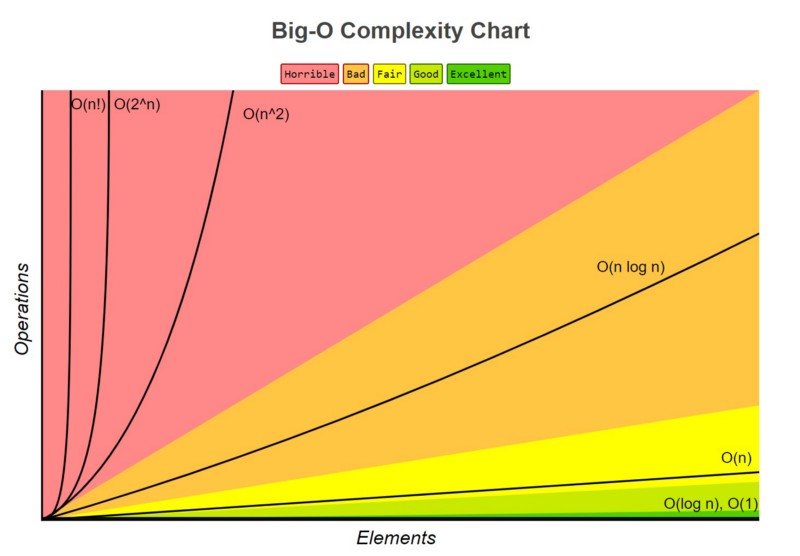
When working with Big-O notation, we always focus on the worst-case
1-6 Visual Comparison of different time complexity
Recognizing Patterns in Big-O Notation
O(n) — Linear Time Example
for (let i = 0; i < n; i++) {
    // code that runs n times
}
Key Points:
n= number of elements in the collection- The number of operations increases proportionally to the size of the input
- Each element is visited once
- Examples:
arr.map(),arr.forEach(),arr.find()
O(n²) — Quadratic Time Example (Nested Loops)
for (let i = 0; i < n; i++) {
    for (let j = 0; j < n; j++) {
        // code that runs n * n times
    }
}
Key Points:
- Two nested loops, both looping over
nelements - Total operations:
n × n = n² - Performance drops quickly as
ngrows - Example: basic implementations of Bubble Sort, checking all pairs in an array
O(1) — Constant Time Example
function getFirstElement(arr) {
    return arr[0];
}
Key Points:
- Time taken does not depend on the size of the input (
n) - Only a single (or fixed number of) operation(s), no matter how big the array is
- Examples: accessing a specific element in an array, simple arithmetic, variable assignment
Multiple Loops (One After Another, Different Sizes)
for (let i = 0; i < n; i++) {
    // code that runs n times
}

for (let j = 0; j < m; j++) {
    // code that runs m times
}
Key Points:
- The two loops are not nested—the first runs
ntimes, then the second runsmtimes. - Total operations:
n + m - In Big O notation:
- If both
nandmcan grow independently, the time is O(n + m). - If
mis much smaller thann, or ifmis a constant, we usually drop the smaller or constant terms. - Big O describes the upper bound, so we focus on the term that grows the fastest as the input increases.
- If both
Why does O(n + m) = O(n) when n > m?
- Suppose
nis always greater thanm(for example,n = 1000,m = 10). As you increase the size ofn, the effect ofmon the total runtime becomes less significant. - In Big O notation, lower-order terms are dropped because they don't significantly affect growth as the input size increases.
- So, O(n + m) = O(n) if
ndominatesm(i.e.,n > m).
What about n + n?
for (let i = 0; i < n; i++) {
    // code that runs n times
}

for (let j = 0; j < n; j++) {
    // code that runs n times again
}
- The total operations here are
n + n = 2n. - In Big O notation, we drop constant factors (
2nbecomes justn), so this is still O(n).
Summary:
- When two loops run one after another (not nested), add their counts.
- Drop constants and lower-order terms for Big O, so O(n + m) ≈ O(n) if n dominates, and O(2n) becomes O(n).
for (let i = 0; i < n; i++) {
    // code that runs n times
}

for (let j = 0; j < m; j++) {
    // code that runs m times
}
Key Points:
- The two loops are not nested—the first runs
ntimes, then the second runsmtimes. - Total operations:
n + m - In Big O notation, if
nandmcan grow independently, the time is O(n + m). - If
nis always much larger thanm, the loop with sizenwill dominate the runtime. - Each loop processes its own set of elements. Example of O(1):
Let's say you have a big array, but you only loop with a fixed condition, such as i < 10:
const arr = [
    /* a big array with many elements */
];

for (let i = 0; i < 10; i++) {
    // This loop will run exactly 10 times, regardless of arr.length
    console.log(arr[i]);
}
- No matter how big
arris, the code inside the loop runs 10 times. - The runtime does not depend on the size of the array.
- This is O(1) (constant time), because the number of operations is fixed and doesn't grow as the input gets larger.
Other classic examples of O(1):
// Accessing a specific element:
const first = arr[0];
const last = arr[arr.length - 1];

// Setting a variable:
let x = 42;
These operations always take the same time, no matter how big the input is.